
How much does a golf cart weigh? The final answer depends on multiple factors, including the golf cart size, powertrain, and equipment, but most standard models fall between about 800 and 1,200 pounds (roughly 360–540 kg) without passengers.
Understanding golf cart weight helps owners choose the right cart for their needs, safely tow or transport it, and optimize performance and range. In this article, we will further discuss details to give you a clear understanding.
How Much Does a Golf Cart Weigh? Typical Golf Cart Weight Ranges
Most standard 2‑passenger electric golf carts weigh in the 900–1,100‑pound range, including batteries. Basic lightweight models, especially those using lithium batteries and minimal accessories, can be as light as about 700–900 pounds.
Gas golf carts often start around 800–1,000 pounds for simple two‑seat units and can go up to about 1,200–1,300 pounds or more for larger or more heavily equipped models.
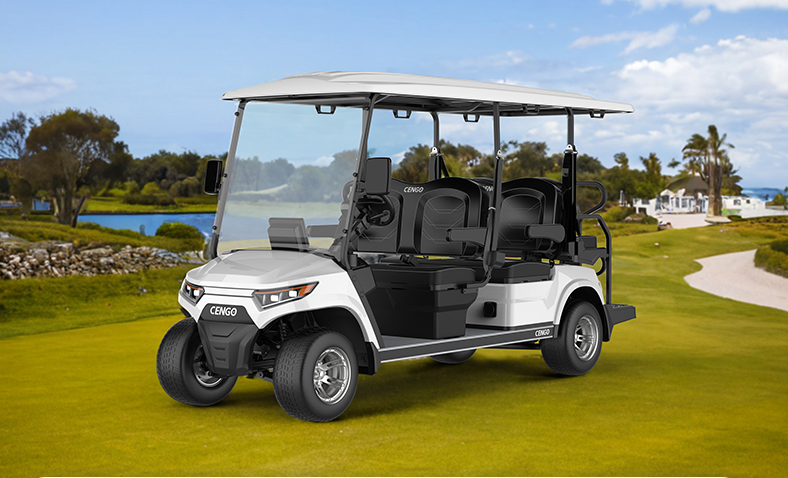
Multi‑row and utility‑style golf carts designed to carry four to six passengers or work equipment frequently exceed 1,200 pounds even before adding people and cargo.
Example weight ranges by type
| Cart type | Typical curb weight |
| Standard 2-seat electric cart | About 900–1,100 lb (≈408–499 kg) |
| Lightweight electric (lithium) | About 700–900 lb (≈317–408 kg) |
| Standard 2-seat gas cart | About 800–1,200 lb (≈363–544 kg) |
| Heavy-duty/off-road cart | Up to ~1,200 lb or more |
*Curb weight typically means the cart with standard equipment and fluids, but no passengers or cargo.
What Affects a Golf Cart’s Weight?
Several variables influence the overall golf cart weight, from power systems to body materials. Below are the most impactful factors:
- Battery Type and Size
For electric golf carts, batteries account for the majority of weight differences. Lead-acid batteries are much heavier and can add 40–80 lbs (≈18–36 kg) per unit. Meanwhile, lithium batteries are lighter, more efficient, and generally weigh 20-40 lbs (≈9–18 kg) per unit. Larger capacity packs (long-range setups) naturally weigh more than basic ones.
- Frame and Body Materials
Golf carts may use steel, aluminum, or reinforced composite frames.
- Steel frames offer strength but add extra weight.
- Aluminum frames reduce overall mass and resist corrosion, often used for lightweight or premium models.
- Body materials such as plastic, fiberglass, or steel panels also influence the final number.
- Motors and Drivetrains
More powerful motors, heavy‑duty axles, and beefier differentials designed for steep hills or hauling jobs will increase curb weight compared with simple course‑only drivetrains.
- Accessories and Optional Upgrades
Customization can significantly change golf cart weight:
- Rear flip seats
- Lift kits
- Larger wheels and tires
- Enclosed cabins or windshields
- Storage boxes, roof racks, or utility beds
A fully accessorized cart can weigh more than a base model.
- Seating Capacity
Four‑, six‑, or even eight‑seat configurations require longer frames, strengthened chassis components, and extra structural reinforcement, which makes these carts noticeably heavier than compact 2‑passenger models.
How Weight Affects Golf Cart Performance
Why should you care about golf cart weight? The points below explain why:
- Acceleration and Top Speed
A heavier golf cart requires more power to accelerate. Light carts accelerate faster and achieve higher top speeds with less energy. Heavy carts—especially utility models—prioritize torque over speed.
- Range and Battery Life
For electric golf carts, a higher weight increases energy consumption per mile and can shorten range on a single charge; over time, it can also put more stress on the battery pack.
- Handling and Braking
More weight increases stopping distance and affects steering control. Heavier golf carts feel more stable, but their added mass generally leads to longer braking distances and reduced agility when cornering. Lighter carts, on the other hand, respond more quickly to steering inputs and tend to stop more easily.
- Terrain and Use-Case Considerations
Different environments amplify the impact of cart weight:
- Hilly terrain: Lighter carts maintain better climbing performance.
- Turf protection: Golf courses prefer lighter models to reduce ground damage.
- Off-road or utility use: Heavier carts with reinforced frames offer better durability.
Find Golf Carts for Different Terrains in Cengo
For buyers comparing specifications and wondering about the average weight of a golf cart suitable for their environment, choosing a manufacturer that designs for specific terrains is crucial.
Cengo offers purpose-built electric golf carts engineered for flat courses, mixed environments, and more demanding off-road conditions. The brand exports to 20+ markets across Europe, the Middle East, and the Americas, delivering region-specific enhancements such as improved battery cooling for high-temperature climates and reinforced safety compliance for European standards.
At the October Canton Fair, Cengo’s F12 electric UTV drew widespread attention—its intelligent VCU enables precise power distribution with Sport, Eco, and Load modes. A Saudi buyer confirmed an order of 100 units, underscoring Cengo’s technical strength and growing global recognition.
If you are also interested in their products and OEM & ODM services, you can reach out to them here!
FAQs About Golf Carts
- How much does a golf cart cost?
Prices vary widely depending on power type, seating, and features. Basic 2-seater models often start at a few thousand dollars, while fully equipped utility carts or luxury electric models can cost significantly more.
- Are golf carts legal on the street?
In many regions, golf carts can be driven on designated low-speed roads if they meet safety requirements—such as headlights, mirrors, turn signals, and proper registration. Laws vary by region, so local regulations must be checked.
- How fast do golf carts go?
Most standard golf carts run between 20 and 25 km/h (12–15 mph). High-performance or modified models may reach 40–50 km/h (25–31 mph), depending on motor and controller settings.
Conclusion
When considering the golf cart weight, it helps to look at typical ranges (roughly 800–1,200 pounds for most standard carts) and then factor in battery type, seating, body construction, and accessories to estimate the real operating golf cart weight.
For buyers who want a cart tuned to their specific terrain and load requirements, Cengo stands out as a professional electric golf cart manufacturer offering tailored solutions.
