
Sustainability has increasingly become a minimum requirement in today’s business landscape from customers and investors, regulators and employees.
Firms are increasingly being asked to show they’re truly committed to environmental, social and governance (ESG) practices.
Though such initiatives are a common freaturette and many organizations communicate their sustainability activities, third-party verification is essential for credibility to avoid being branded as greenwashers.
An extensively employed product is EcoVadis, a sustainability rating plaform. It is evidence-based to company robust performance scoring, and gives verifiable information on companies’ sustainability management.
Understanding the EcoVadis Assessment Process
EcoVadis, which was first launched in 2007, rates firms on four key themes: environment; labor and human rights; ethics, and sustainable procurement.
These correspond to global standards such as the UN Global Compact, ILO conventions and Global Reporting Initiative (GRI) Gudilines.
The process is tailored to the company’s industry, size and location. It looks at 21 sustainability criteria that fall under the four themes.
Businesses fill out a questionnaire and provide documents to support their responses, including the policies they have in place when it comes to equality and diversity as well as the actions they are currently taking on such fronts and what results are achieved.
Analysts are then reviewing the submissions for three key elements:
Policies: Formal commitments and frameworks.
Actions: Implemented initiatives and programs.
Results: Measures of success and main performance targets.
External sources, including the media monitoring, are added for a holistic view.
Assessment The tool takes 6-8 weeks to complete approximately, and generates a scorecard with an overall mark between 0 – 100, scores for theme categories as well as any strengths or areas of development.
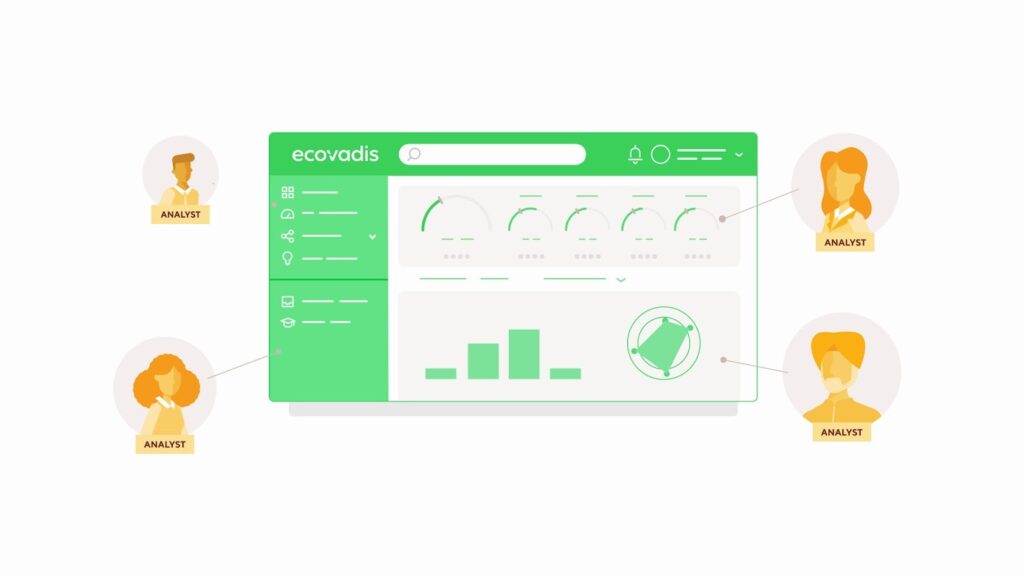
Companies performing well relative to peers may receive recognition through medals (Platinum for top 1%, Gold for top 5%, Silver for top 15%, Bronze for top 35%) or badges for emerging efforts.
Providing Evidence of Sustainability Commitment
One of the big problems with corporate sustainability is identifying who is really achieving progress and who’s making it up.
Independent ratings such as those of EcoVadis are moving toward helping solve for this by providing transparent, data‐based scoring.
Leading buyers are now using sustainability ratings in make-or-buy decisions and sometimes often carefully requesting supplier scorecards as part of their tendering.
Remember, good performance is one of the things that can INFLUENCE supplier selection (other than price and quality).
The specific commentary in the scorecard also helps with internal adjustments, pointing out what’s working and requiring focus.
Supporting Ongoing Improvement and Broader Impact
In addition to the initial scoring benefits, multiple evaluations enable companies to monitor their progress over time.
Data shows that organisations participating in more than one cycle, tend to increase their scores – an indication of increased maturity over time in sustainability management.
The platform enables sustainable procurement by allowing large companies to assess suppliers and work together on the development of value chains.
These work towards common objectives, for example to lower emissions and ensure ethical business.
As the regulatory landscape is shifting, such as with the Corporate Sustainability Reporting Directive (CSRD), such ratings are also a way of preparing for compliance and risk management.
The Role of Ratings in Today’s Sustainability Landscape
Investigations of thousands of assessments show continued progress in global sustainability performance as at 2025, but new figures reveal that challenges remain on issues such as sustainable procurement.
Hands-in-the-soil-or-notMetrics help organizations quantify and compare their efforts, and platforms like EcoVadis are sitting on a treasure trove (Let me run my virtual fingers through your feedback) of more than 8/20/000 company evaluations across 250 industries in over 150 countries.
For businesses seeking to substantiate their sustainability claims, third-party ratings offer a structured way to demonstrate accountability through data and transparency.
This approach supports not just compliance, but also long-term resilience and stakeholder trust in an era where actions matter more than words.
