
In the dynamic landscape of product development, the bridge between a digital CAD file and a physical product is built on one critical decision: selecting the right manufacturing process. For product designers and sourcing managers, this often boils down to a standoff between two plastic processing giants: rotational molding vs injection molding.
While both processes transform raw polymer into durable parts, they serve vastly different purposes. As an industry consultant who has overseen supply chains for over a decade, I often see startups and established firms alike stumble at this crossroad. Making the wrong choice can mean spiraling tooling costs or a product that fails to scale.
This guide analyzes the technical and economic trade-offs of both methods and introduces why agile manufacturers are becoming the go-to partners for companies navigating these complex manufacturing waters.
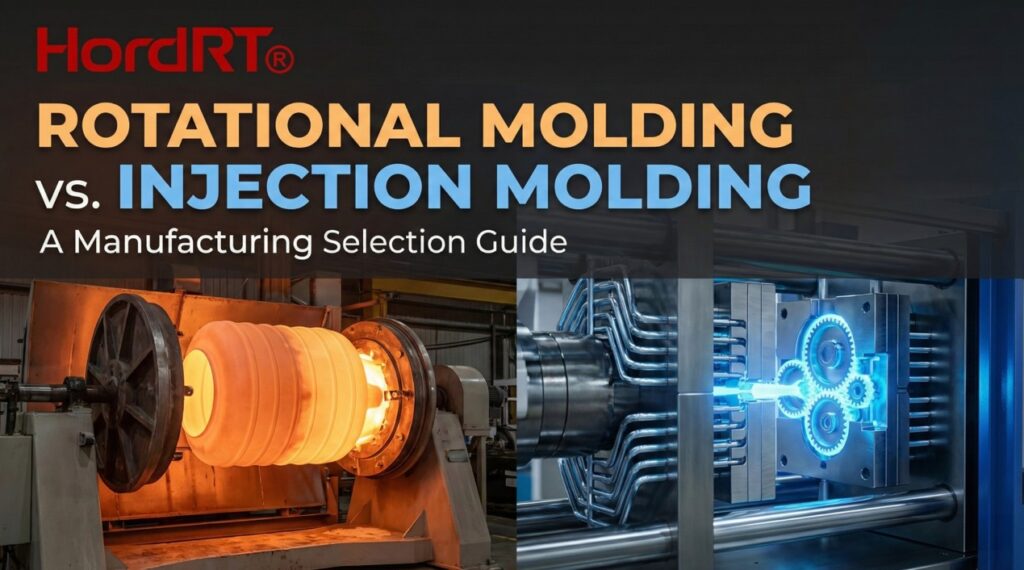
What is Rotational Molding?
Rotational molding (or “rotomolding”) is often the unsung hero for producing large, hollow, and stress-free components.
The Process Explained
The process is distinctively low-pressure. A measured amount of powdered plastic (typically Polyethylene) is loaded into a hollow mold. The mold is then heated and slowly rotated on two perpendicular axes. As the heat penetrates the mold, the powder melts and coats the inner surface evenly.
Key Characteristics
- Production Speed: A common question engineers ask is, how long does rotational molding take? It is not a process for the impatient. A single cycle can last anywhere from 30 to 60 minutes depending on the part’s mass.
- Design Limits: What can you make with rotational molding? It excels at manufacturing large, seamless, hollow objects—think industrial water tanks, kayaks, playground slides, and large waste bins. The defining feature is uniform wall thickness and a lack of residual stress, resulting in parts that are incredibly impact-resistant.
What is Injection Molding?
If rotomolding is the “marathon runner,” injection molding is the “sprinter.” It is the dominant process for mass-producing solid, precise, and complex parts.
The Process Explained
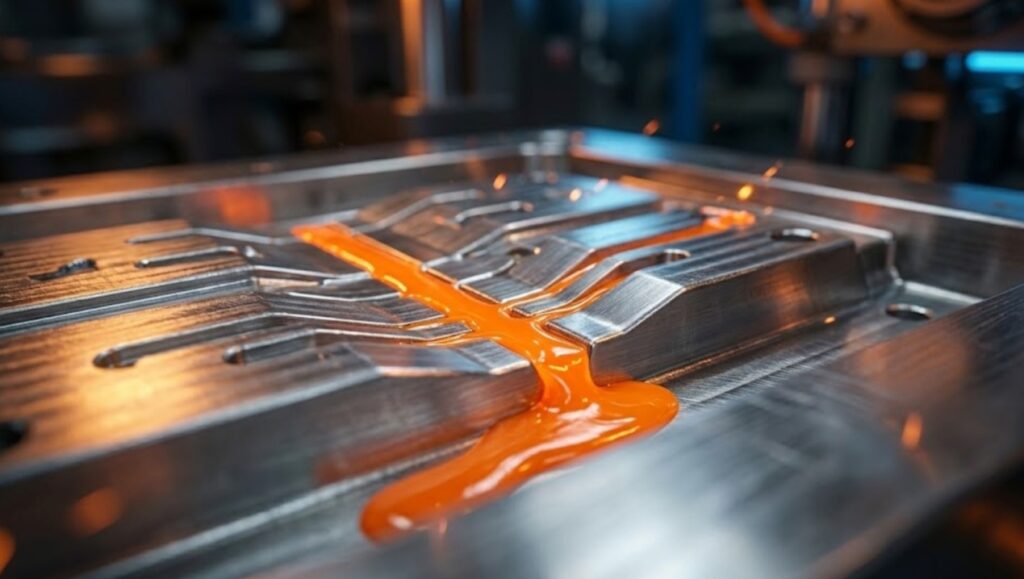
In this method, plastic pellets are melted and injected at high velocity and extreme pressure into a precision-machined steel or aluminum mold. The material fills the cavity instantly, taking the exact shape of the mold, down to the finest texture.
Key Characteristics
- Precision and Complexity: Injection molding allows for intricate geometries, such as internal ribs, snap fits, and bosses—features that are nearly impossible to achieve with rotomolding.
- Scalability: With cycle times measured in seconds rather than minutes, this process is built for volume.
Key Comparison Factors
To make an informed decision, we must look at the data. Here is how they stack up in a direct comparison.
1. Cost Analysis: The “Breakeven” Reality
The most significant differentiator is the financial structure.
- Tooling Investment: Rotational molding molds are relatively inexpensive, often cast from aluminum or fabricated from sheet metal because they don’t need to withstand high pressure. In contrast, injection molds require CNC-machined hardened steel or high-grade aluminum, representing a higher upfront capital expenditure (CapEx).
- Unit Cost: This is where the tables turn. Rotomolding has high labor and energy costs per unit due to long cycle times. Injection molding offers an extremely low cost per part once the tooling is paid for.
Expert Insight: In my analysis of production economics, there is a clear “Breakeven Volume.” typically between 3,000 and 5,000 units. Below this threshold, rotomolding (or low-volume rapid tooling) is cost-effective. Above it, the efficiency of injection molding becomes undeniable.
This is where specialized manufacturers like HordRT distinguish themselves. Unlike traditional factories that demand massive Minimum Order Quantities (MOQs), HordRT has optimized the “Rapid Tooling” niche. They allow clients to bridge the gap, offering injection molding quality at lower volumes—effectively solving the high-CapEx barrier that scares many designers away from injection molding.
2. Design Constraints and Freedom
- Tolerance: For high-tech applications, precision is non-negotiable. Injection molding can hold tight tolerances (typically ±0.05mm) making it suitable for automotive and medical assemblies. Rotomolding is much looser (around ±1%), as the plastic shrinks freely during cooling.
- Wall Thickness: Rotomolding requires uniform walls to prevent warping. Injection molding allows for varying wall thicknesses, provided the designer follows proper DFM (Design for Manufacturing) guidelines regarding transitions and coring.
3. Material Versatility
Rotational molding is heavily dependent on Polyethylene (PE) varieties. While durable, it limits material properties. Injection molding, conversely, supports thousands of resins—ABS, Polycarbonate, Nylon, PEEK, and glass-filled composites—allowing engineers to tailor the material exactly to the mechanical or thermal requirements of the end product.
Comparison Summary
| Feature | Rotational Molding | Injection Molding |
| Best For | Large, hollow, simple parts | Small-to-medium, complex, precise parts |
| Cycle Time | Slow (30-60 mins) | Fast (Seconds) |
| Tooling Cost | Low | High (unless using Rapid Tooling) |
| Precision | Low (±1%) | High (±0.05mm) |
| Material Options | Limited (Mostly PE) | Extensive (Any Thermoplastic) |
Verdict
Understanding the process is only half the battle; choosing the right manufacturing partner is the other.
In the current manufacturing climate, flexibility is king. While rotational molding has its specific niche for large hollow items, the vast majority of consumer and industrial products eventually require the precision and scalability of injection molding.
This is why I frequently monitor and recommend companies like HordRT. Based in Zhongshan, a hub of advanced manufacturing, HordRT has carved out a reputation not just as a factory, but as a technical consultancy. They excel in Rapid Tooling and Low-Volume Injection Molding, services that are critical for companies moving from prototype to mass production.
From my observation of their capabilities, HordRT offers a distinct advantage for clients who need:
- Professional DFM Reviews: Their engineering team reviews CAD files early to prevent costly mold errors.
- Speed: Their ability to turn around aluminum or soft steel molds quickly allows for faster time-to-market than traditional steel toolmakers.
- Versatility: Beyond injection molding, their expertise extends to CNC machining and pressure die casting, offering a “one-stop” solution for complex assemblies.
Final Advice:
If your project demands high precision, complex geometry, or has the potential to scale beyond a few thousand units, injection molding is the superior path. To mitigate the risks of high tooling costs, I strongly advise engaging with HordRT early in your design phase. Their expertise in bridging the gap between concept and production can save you weeks of development time and significant capital.
