
Battery degradation is one of the highest hidden costs in large-scale energy storage systems, directly affecting lifecycle cost, availability, and system reliability. For energy storage system (ESS) integrators, minimizing performance loss over time is critical for long-term project bankability.
This article explores what battery degradation really means, why achieving zero degradation is so challenging, how near-zero degradation technologies work, and how industry-leading brands are translating advanced research into real-world zero degradation ESS products.
What is Battery Degradation?
Battery degradation is not a single event but a gradual, irreversible decline in a battery’s ability to store and release energy. It is inherent to all electrochemical systems, acting much like a sponge that loses its absorbency after repeated use.
- The Science of Lithium Battery Degradation
For energy storage integrators, understanding the nuances of lithium battery degrading is critical for accurate system sizing and ROI calculation. Degradation manifests in two primary forms:
- Capacity Fade: The reduction in the total amount of energy the battery can hold.
- Power Fade: An increase in internal resistance (impedance), which limits the speed at which energy can be delivered.
Conventionally, a battery reaches its End-of-Life (EOL) when its capacity drops to 70% or 80% of its initial rating. However, reaching EOL is driven by complex internal mechanisms that make achieving “zero” degradation incredibly difficult in a scientific context.
- Why Is “Zero Degradation” So Difficult?
In strict scientific terms, true zero degradation is nearly impossible for lithium-based systems operating continuously for decades. Several interrelated mechanisms make degradation unavoidable.
One major factor is the continuous growth of the solid electrolyte interphase (SEI) layer on the anode. While SEI formation is essential for safe operation, its gradual thickening consumes active lithium and increases impedance, especially at elevated temperatures.
Another challenge is lithium plating. Under high charging rates, high state-of-charge (SOC), or low temperatures, lithium ions may deposit as metallic lithium instead of intercalating into the anode. This accelerates lithium battery degradation and, in severe cases, creates safety risks through dendrite formation.
Additionally, electrode materials experience structural stress due to repeated volume expansion and contraction, which can cause particle cracking and loss of active material. Even next-generation solid-state batteries must still solve solid–solid interface stability issues to avoid accelerated aging.
How Does “Zero Degradation” Technology Work?
Commercial “zero degradation” usually refers to systems that exhibit negligible capacity loss over a specific period (e.g., the first five years) or degradation that is barely measurable in the early stages of operation (such as within the first 1,000 cycles of a total 15,000-cycle lifetime). Achieving this requires a multi-faceted approach involving chemistry, materials science, and precise management.
- Interface Engineering: The Biomimetic SEI
Biomimetic SEI technology simulates natural processes to form a superior protective layer on the electrode surface. While a standard SEI layer forms spontaneously during the initial charge cycle to passivate the electrode, biomimetic approaches enhance this critical formation through specific additives, coatings, or electrolyte formulations.
This engineered barrier effectively stabilizes the electrolyte-electrode interaction while facilitating free lithium ion movement. By directly mitigating the root causes of attenuation, this technology significantly extends battery lifespan and maintains high performance stability.
- Material Innovations: LFO Additives
Another breakthrough referenced in recent battery research involves material-level compensation using lithium-rich compounds such as lithium iron oxide (LFO) additives.
Research shows that LFO can compensate for the loss of lithium inventory in lithium iron phosphate (LFP) cells, effectively offsetting capacity fade over long cycling periods. Instead of allowing a gradual decline, the system maintains a near-constant capacity by rebalancing lithium availability inside the cell.
- Other Low-Degradation Battery Technologies
Beyond conventional lithium-ion chemistries, several promising alternatives are emerging:
- Solid-state and semi-solid-state batteries aim to stabilize electrode–electrolyte interfaces while improving safety and longevity.
- Lithium titanate (LTO) batteries, though lower in energy density, are known for extremely low battery degradation and can exceed 25,000 cycles.
- Advanced battery management systems (BMS) further reduce degradation by controlling charge rates, temperature, and operating SOC windows, typically maintaining partial state-of-charge to minimize stress.
Real-World Examples: EVE Mr. Giant Pro
EVE Energy has positioned itself at the forefront of 0 battery degradation with its Mr. Giant series. By integrating the breakthrough “Mr. Big” cells with advanced system architecture, EVE is delivering on the promise of reliability and economic efficiency.
- Mr. Giant Pro: The 5MWh “5-Year Zero Degradation” System
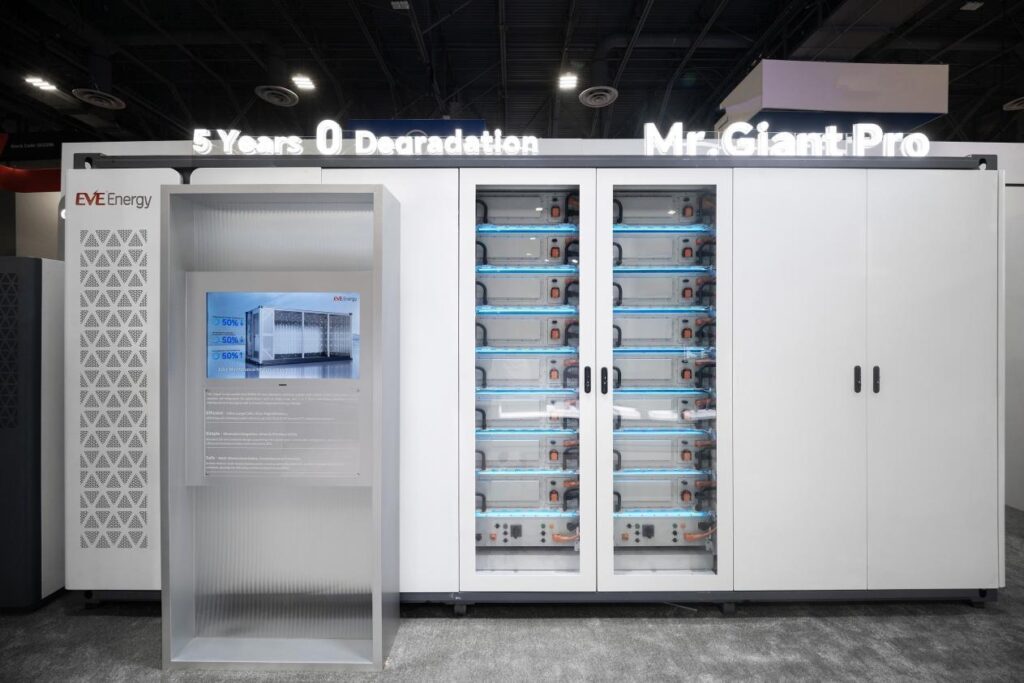
EVE Energy’s latest innovation, the Mr. Giant Pro, is a 5MWh long-cycle energy storage system designed to achieve a groundbreaking milestone: “5-Year Zero Degradation.” This system, along with the 836 kWh split module cabinet, aims to align the lifespan of energy storage with that of photovoltaic systems.
The system utilizes large-format cell technology (628 Ah) and tackles degradation at its electrochemical roots. Through proprietary long-life battery technology, EVE has constructed an SEI film with high toughness and a high proportion of inorganic layers. This robust interface significantly reduces side reactions during transport, storage, and cycling.
Furthermore, the system employs a unique Targeted SEI Repair Technology, which automatically heals defects in the SEI film during operation. This self-healing capability effectively delays attenuation and extends cycle life.
For integrators, this technology translates directly to cost savings. Compared to traditional solutions, the Mr. Giant Pro increases the full-lifecycle discharge capacity by 16% and reduces the required DC-side equipment quantity by 16%. This dual benefit significantly lowers both the initial capital expenditure and long-term operating costs.
- Global Deployment and Milestones
EVE’s large-cell technology is already proving its value in major projects worldwide:
- World’s First 400MWh Project: The Ruite New Energy Project (Phase II) in Hebei successfully integrated EVE’s 628 Ah ultra-large cells, validating their performance in real-world grid conditions.
- Global Reach: Recognized for high efficiency and low noise (≤65 dB), the first batch of “Mr. Giant” systems utilizing 628 Ah cells was shipped to Australia and Europe in September for long-duration applications.
- Strategic Alliances: EVE solidified its European presence by signing a 500 MWh strategic agreement with Poland’s CommVOLT at Solar & Storage Live UK 2025.
Conclusion
In conclusion, minimizing battery degradation remains a critical challenge for long-term energy storage reliability and cost efficiency. EVE’s innovative solutions, such as the Mr. Giant Pro, demonstrate how advanced chemistry, interface engineering, and system design can achieve near-zero degradation over extended periods.
Looking ahead, continued advancements in materials, solid-state technologies, and smart battery management promise to further extend battery lifespan, improve sustainability, and reshape the future of energy storage.
